

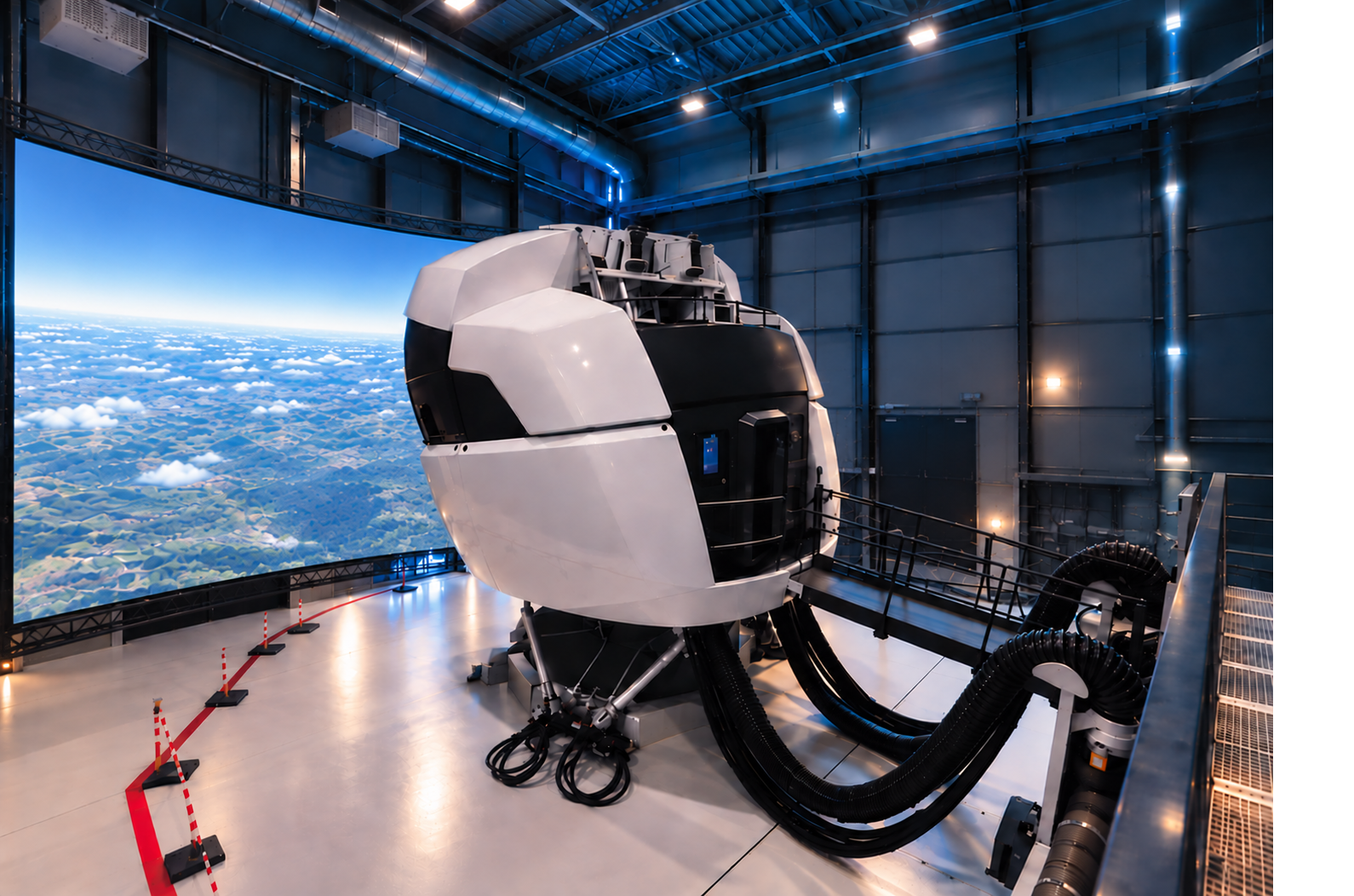
Military simulation must respond dynamically to the trainee rather than reproduce a predictable operating environment. Scenarios including air-to-air refuelling, countermeasures and in-theatre engagements require extensive visual databases to be processed with the necessary clarity and responsiveness. The customer required imagery to span four projected displays as a single seamless view, without timing differences between the individual graphics channels.
The Image Generation system also needed to operate alongside the host computer controlling the hydraulic motion platform beneath the cockpit. Latency across the visual, control and motion systems therefore would need to be carefully managed to keep the displayed environment residential aligned with physical movement.
The existing configuration housed its graphics cards in separate computers across two equipment racks, increasing the space, cabling, power, cooling and management requirements.
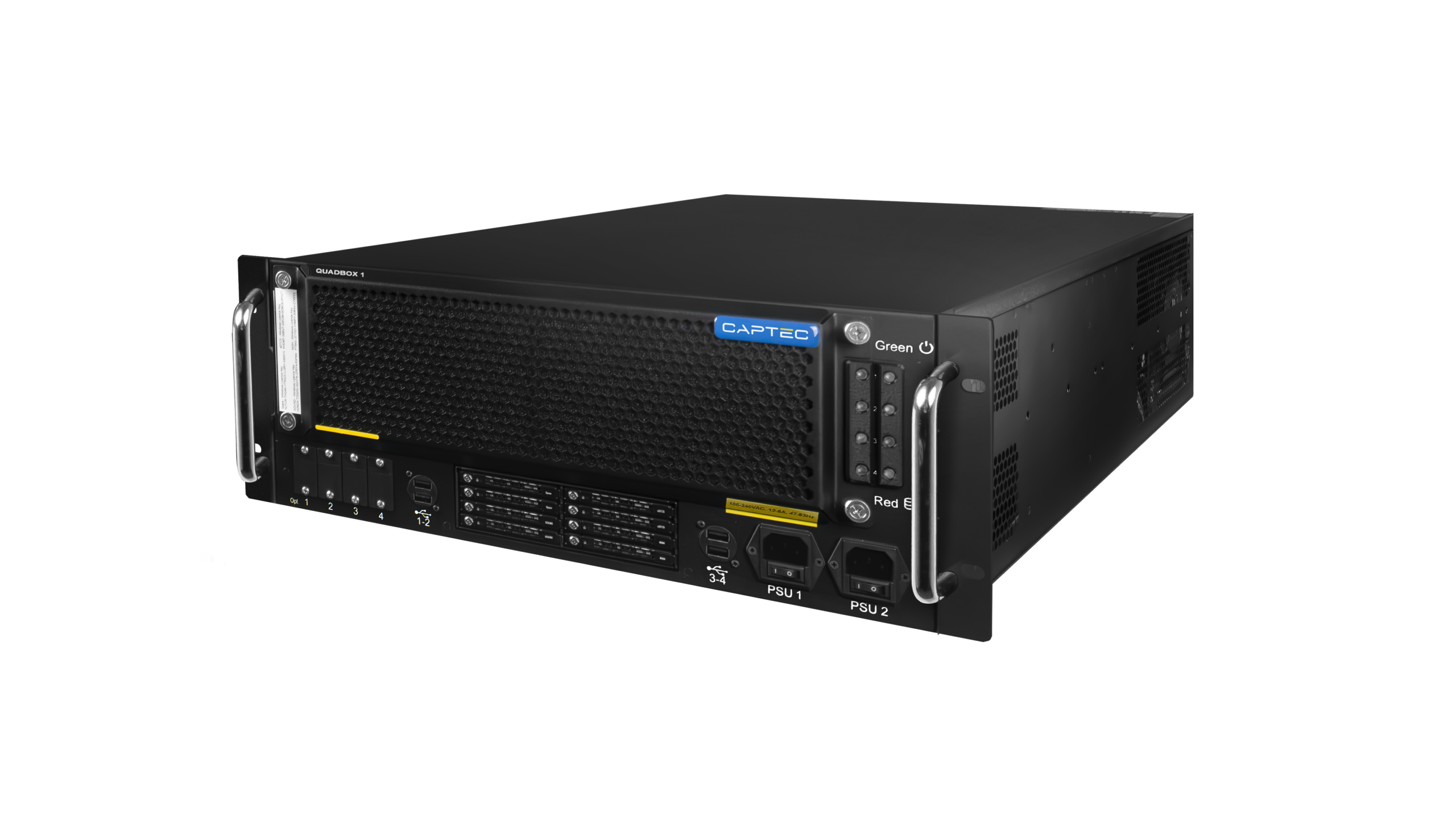
Captec developed the MN-01 as a 4U multi-node GPU server containing four independent Image Generation nodes. Each incorporated its own processor, memory, storage, network interfaces, and NVIDIA® RTX or Quadro® graphics, providing the functionality of four separate computers within one chassis.
An integrated NVIDIA Quadro Sync card coordinated the independent graphics outputs, enabling four projected displays to present one continuous image without visible timing differences or artefacts. The system was fine-tuned for near real-time processing and visual clarity, while its internal layout and cable configuration helped minimise latency between the computing hardware, projection equipment and simulator controls.
Optimised component positioning and thermal engineering managed the concentrated CPU and GPU loads. Dual 1200 W power supplies provided capacity and redundancy, while front accessible I/O, removable storage and network connectivity simplified ongoing management.
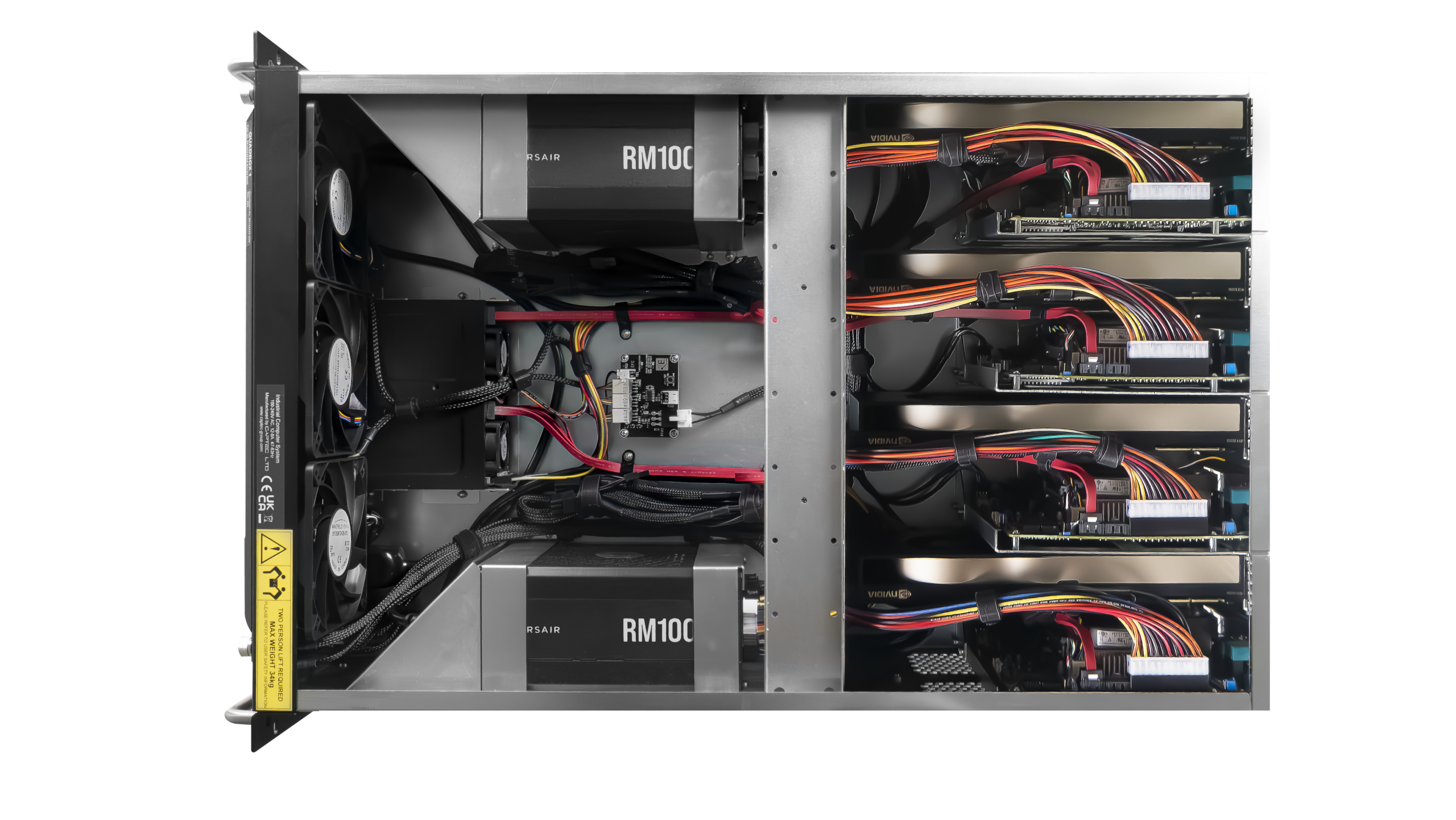
Captec consolidated 20 individual computers into five MN-01 systems, reducing the Image Generation installation from two racks to one. Bringing the hardware together shortened cable runs and helped minimise latency between the computing, projection and simulator-control systems.
The customer gained a more compact and manageable installation that simplified cabling, supporting infrastructure, logistics and maintenance without compromising the processing and graphics performance required by the simulator. Configurable variants have incorporated a live spare node for resilience or two active nodes with additional capacity for expansion cards.
Captec continues to support technology refreshes across deployed systems, maintaining interoperability as computing and graphics technologies evolve. The MN-01’s use within simulators for Voyager, A400M and Hawk aircraft, alongside Type 31 bridge training, demonstrates a proven, adaptable foundation for future immersive simulation requirements.